
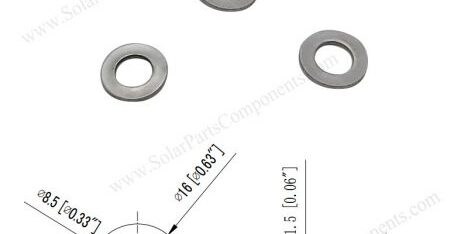
When designing a solar array, engineers meticulously calculate wire gauges and grounding rod depth. However, the most common point of failure in the electrical safety chain is often the smallest and most overlooked: the flat washer. Specifically, the M8 flat washer used in bonding jumpers and grounding lugs is not just a piece of metal; it is the critical interface that ensures a low-resistance path for fault current. For EPC contractors and asset managers, understanding the mechanical and electrical properties of this component is essential to preventing system downtime and ensuring compliance with NECand IECstandards. This guide explains why the humble washer is a non-negotiable element of a safe PV system.
1. More Than a Spacer: The Electrical Mechanics of a Grounding Washer
In a solar grounding system, the washer’s primary function is to create a massive metal-to-metal contact area between the conductor and the mounting rail or frame. A standard washer may suffice for mechanical fastening, but a grounding application demands more.
-
Contact Resistance Reduction: When a fault current occurs (e.g., from a damaged cable or lightning surge), the electricity seeks the path of least resistance. A high-quality M8 flat washer, with its precisely machined flat surface, maximizes the contact area. This reduces the electrical resistance at the connection point, ensuring that the current flows through the grounding conductor rather than arcing or heating up at a poor connection.
-
Corrosion Prevention: The washer acts as a sacrificial barrier. Made from materials like stainless steel 304 or 316, it resists galvanic corrosion that can occur between dissimilar metals (e.g., an aluminum rail and a copper grounding lug). This corrosion resistance is vital for maintaining electrical continuity over the system’s 25-year lifespan.
-
Pressure Distribution: The washer distributes the clamping force of the bolt evenly across the surface of the conductor. This prevents the thin metal of a grounding lug from deforming under torque, which could loosen the connection over time and increase resistance.
2. Material Superiority: Why 304/316 Stainless Steel is the Standard
The choice of material for a grounding washer is a direct trade-off between corrosion resistance and electrical conductivity. While copper is more conductive, it is soft and prone to corrosion.
-
Stainless Steel 304: This is the most common choice for inland solar farms. It offers an excellent balance of strength, corrosion resistance, and cost-effectiveness. Its passive oxide layer protects it from rust in most atmospheric conditions.
-
Stainless Steel 316: For coastal sites or areas with high salinity, 316 stainless steel is mandatory. The addition of molybdenum provides superior resistance to chloride-induced pitting and crevice corrosion, which can quickly degrade standard carbon steel or even 304 stainless washers.
-
Zinc Plating Risks: While zinc-plated carbon steel washers are inexpensive, they are not recommended for long-term grounding. The zinc coating can wear off or corrode, leading to high resistance and potential connection failure. For a 25-year asset, stainless steel is the only viable option.
3. The Installation Pitfall: Torque Values and the “Feel” of a Secure Connection
A washer is only effective if it is installed correctly. The most common error in solar grounding is under-torquing or over-torquing the fastener.
-
The Goldilocks Torque: For a standard M8 stainless steel bolt and washer combination, the recommended torque is typically between 15-20 Nm. Under-torquing fails to compress the washer and conductor sufficiently, leaving air gaps that increase resistance. Over-torquing can strip the threads of the bolt or crack the aluminum rail, creating a structural weakness.
-
The “Bite” Test: A properly torqued washer will leave a slight impression on the aluminum rail. This indicates that the connection has achieved the necessary metal-to-metal contact. If the washer can be easily spun after tightening, the connection is not secure.
-
The Role of Serrated Washers: In some high-vibration environments (like carports or floating solar), a serrated or star washer may be used under the flat washer. The teeth of the serrated washer bite into the metal, preventing loosening from thermal cycling or wind-induced vibration.
4. The Cost of Compromise: Why Washer Quality Impacts ROI
Sourcing cheap, non-standard washers is a false economy that can lead to catastrophic failure.
-
Hot Joints: A poor connection creates high resistance, which generates heat under normal operating current. This heat can degrade the insulation of nearby cables, melt plastic components, and in extreme cases, ignite a fire. Infrared thermography inspections often reveal these “hot joints” long before they fail completely.
-
Lightning Protection: A faulty grounding connection can prevent a lightning arrestor from functioning correctly. Instead of safely dissipating the massive electrical surge into the ground, the energy can arc across the array, destroying inverters and modules.
-
OPEX for Troubleshooting: Locating and repairing a single failed grounding connection in a 1 MW solar farm can require hours of diagnostic work and downtime. The labor cost alone far exceeds the few cents saved by using a substandard washer.
For EPC contractors and O&M managers, the M8 flat washer is a critical component of the electrical safety system. Specifying high-grade stainless steel washers and enforcing proper torque procedures during installation is the cheapest insurance policy for a solar asset’s long-term performance and safety.