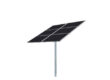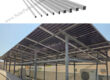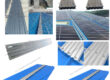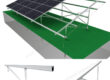

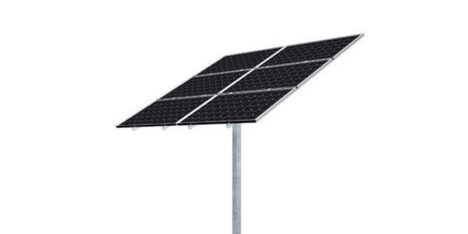
In distributed solar applications such as street lighting, surveillance poles, communication relay stations, and small off-grid PV systems, the mounting pole is often treated as a commodity item — yet its cross-sectional shape, coating durability, and bracket topology directly determine whether the system survives gusty winds or fails at the base weld after a few seasons. Round steel pipes are common but exhibit lower torsional resistance against asymmetric wind loads (e.g., a single-arm solar fixture catching the wind from one side). Quadrate Steel Solar Pole Mounting Systems — Square Section Steel Tube Solar Light Pole Camera Pole Mounting Bracket Single Arm Double Arm Top Mount Hot Dip Galvanized Zn-Al-Mg Coated Q235B Q355B Embedded Foundation Anchor Bolt Wind Load Less Than 45 m/s for Solar Street Light Surveillance Camera Off-Grid PV System (from Solar Parts Components, solarpartscomponents.com) addresses this through a deliberate shift from round to square (quadrate) cross-section: a closed square tube (typically 60×60 mm to 140×140 mm, wall thickness 2.5–4.0 mm) provides inherently higher polar moment of inertia per unit weight than a round pipe of equal circumference, meaning better resistance to twisting when the bracket arm extends horizontally. Combined with hot-dip galvanizing (≥65µm) or Zn-Al-Mg (ZAM) coating on Q235B/Q355B carbon steel, and anchored via embedded foundation bolts or expandable anchor base plates, the system supports single-arm (cantilever), double-arm (balanced), or top-mount (axial) fixture configurations under wind loads up to 45 m/s. But how exactly does square section geometry reduce pole-top rotation under eccentric solar panel weight, why choose Zn-Al-Mg over standard HDG for coastal or humid lamp pole environments, and what foundation method (embedded vs. bolt-down) suits asphalt parking lots versus grassy medians? Below is the full breakdown for municipal lighting engineers, solar street light integrators, security system installers, and infrastructure procurement teams.
Why square (quadrate) steel section outperforms round for cantilever pole mounts
The Quadrate Steel Solar Pole Mounting Systems — Square Section Steel Tube Solar Light Pole Camera Pole Mounting Bracket Single Arm Double Arm Top Mount Hot Dip Galvanized Zn-Al-Mg Coated Q235B Q355B Embedded Foundation Anchor Bolt Wind Load Less Than 45 m/s for Solar Street Light Surveillance Camera Off-Grid PV System (from Solar Parts Components, solarpartscomponents.com) is founded on a mechanical principle often overlooked in pole selection:
-
Higher Torsional Stiffness of Closed Square Sections: For a given cross-sectional area and wall thickness, a square tube has a polar moment of inertia (J) approximately 1.2–1.4× that of a round tube of equal perimeter. This means that when a single-arm solar bracket extends 0.5–1.5 m from the pole face and catches wind from one side, the square pole resists angular deflection (twist) at the top more effectively, keeping the solar panel aimed correctly and reducing fatigue at the bracket-to-pole weld.
-
Flat Faces for Easier Bracket Attachment: Square poles provide four flat mounting surfaces, simplifying drilling, bolting, or clamping of brackets without curved-surface adapters. This reduces installation error and improves torque retention on the bracket bolts.
-
Aesthetic Uniformity in Urban Settings: Many municipalities prefer square or octagonal poles over round for street furniture because they align visually with rectilinear sidewalks and building facades. The quadrate profile integrates better with modern LED luminaire designs.
Key specifications and configuration options (From Solar Parts Components Page)
-
Product Name: Quadrate Steel Solar Pole Mounting Systems
-
Pole Cross-Section: Square (quadrate) closed tube
-
Typical Pole Dimensions: 60×60 mm, 80×80 mm, 100×100 mm, 120×120 mm, 140×140 mm (wall thickness 2.5–4.0 mm per height and load)
-
Standard Height Range: 3 m, 4 m, 5 m, 6 m, 8 m, 10 m, 12 m (custom heights available)
-
Material: Carbon Steel Q235B (general) or Q355B (higher strength for taller/heavier loads)
-
Surface Treatment: Hot-Dip Galvanizing (HDG, ≥65µm per ISO 1461) or Zn-Al-Mg (ZAM) coating for enhanced corrosion resistance in coastal/industrial environments
-
Bracket Types:
-
Single Arm (Cantilever): One fixture or solar panel offset to one side; requires higher torsional resistance
-
Double Arm (Balanced): Two fixtures or panels on opposite sides, canceling eccentric moment
-
Top Mount (Axial): Fixture or panel centered on pole top; minimal torsion, pure compression/bending
-
-
Fixture / Module Compatibility: Solar street light heads, surveillance cameras, small PV panels (50W–400W), communication antennas
-
Foundation / Anchoring:
-
Embedded Base (Direct Burial): Pole inserted into excavated hole and backfilled with concrete; suitable for grass/soil medians
-
Anchor Bolt Base Plate: Flanged base with pre-set J-bolts or expansion anchors; suitable for concrete/asphalt surfaces
-
-
Wind Load Capacity: ≤ 45 m/s (≈162 km/h, typical for most non-cyclonic inland zones)
-
Accessories Available: Cable entry hole, hand hole (inspection door), lightning rod mount, anti-theft bolt kit
-
Design Life: 20–25 years with proper coating and foundation
-
Supplier: Solar Parts Components (solarpartscomponents.com)
Bracket topology: single arm, double arm, and top mount in wind context
The choice of bracket configuration for Quadrate Steel Solar Pole Mounting Systems — Square Section Steel Tube Solar Light Pole Camera Pole Mounting Bracket Single Arm Double Arm Top Mount Hot Dip Galvanized Zn-Al-Mg Coated Q235B Q355B Embedded Foundation Anchor Bolt Wind Load Less Than 45 m/s for Solar Street Light Surveillance Camera Off-Grid PV System (from Solar Parts Components, solarpartscomponents.com) directly affects pole sizing:
-
Single Arm (Cantilever): The solar panel or luminaire extends horizontally from one side, creating a moment arm that induces both bending (at the bracket-to-pole joint) and torsion (along the pole axis). The square section’s higher J-value limits twist to acceptable levels (<1°–2° angular deflection). Pole wall thickness may need to increase by 0.5–1.0 mm vs. balanced configurations.
-
Double Arm (Balanced): Two identical fixtures on opposite sides cancel the eccentric moment, converting the load into pure vertical compression and symmetric bending. This allows lighter poles (smaller section or thinner wall) for the same wind speed, but requires symmetrical solar irradiation and may shade one panel in morning/afternoon.
-
Top Mount (Axial): The fixture sits atop the pole, loading it in pure compression and symmetric bending from wind on the fixture face. No torsion. Simplest structurally but limited to single-fixture applications; the pole top cap must be sealed against water ingress.
Coating strategy: Zn-Al-Mg vs. standard HDG for pole environments
While HDG (≥65µm) is adequate for most inland solar poles, the Quadrate Steel Solar Pole Mounting Systems — Square Section Steel Tube Solar Light Pole Camera Pole Mounting Bracket Single Arm Double Arm Top Mount Hot Dip Galvanized Zn-Al-Mg Coated Q235B Q355B Embedded Foundation Anchor Bolt Wind Load Less Than 45 m/s for Solar Street Light Surveillance Camera Off-Grid PV System (from Solar Parts Components, solarpartscomponents.com) offers Zn-Al-Mg (ZAM) upgrade for aggressive settings:
-
Coastal / Salt-Spray Zones: Streetlights and cameras along coastlines face chloride deposition. ZAM’s Mg-rich corrosion products form a denser barrier, delaying red rust initiation by 3–5× compared to HDG in ASTM B117 salt spray tests.
-
Industrial / Acid Rain Environments: Near factories or heavy-traffic roads, pollutants accelerate Zn consumption. ZAM’s Al+Mg microstructure buffers pH shifts at the coating surface.
-
Cut-Edge Protection: Poles are often cut to custom height on-site or drilled for cable entries. ZAM’s edge-creep resistance seals these exposed zones without touch-up paint.
Foundation methods and site suitability
-
Embedded Base (Direct Burial): Preferred for greenfield installations on soil, grass, or gravel. Excavate a pit (typically 800–1200 mm deep, 3–4× pole diameter wide), insert pole, backfill with concrete (C20/C25), allow 7-day cure. Provides highest pull-out resistance. Suitable for 6–12 m poles.
-
Anchor Bolt Base Plate (Flanged): Used on existing concrete slabs, asphalt parking lots, or rooftops. Four or six J-bolts are cast into a concrete foundation (or expansion-bolted into existing slab), then the pole base plate is bolted down. Faster installation (no concrete cure if using pre-cast or chemical anchors), but requires precise bolt circle alignment. Suitable for 3–8 m poles on hard surfaces.
Typical application scenarios
-
Solar Street Lighting (Municipal / Private Roads): Single-arm or double-arm square poles with integrated PV panel on top or side bracket. 45 m/s wind rating covers most urban and suburban zones. Zn-Al-Mg coating recommended for roadside salt spray.
-
Surveillance / Traffic Monitoring Poles: Cameras and small radar units mounted via single-arm bracket; square section resists camera shake better than round under gust loads. Cable entry holes pre-drilled at factory.
-
Off-Grid Communication / IoT Gateways: Small radio antennas or LoRaWAN gateways on top-mount poles; minimal torsion, focus on foundation stability.
-
Parking Lot and Pathway Lighting: Double-arm balanced configuration reduces pole cost per fixture; embedded base on grass medians, flanged base on asphalt.
Installation sequence and quality assurance
-
Foundation Preparation: For embedded base, dig pit to depth per pole height and soil class; place gravel base for drainage. For flanged base, cast concrete pad with bolt template or drill expansion anchors.
-
Pole Positioning: Set pole vertical using spirit level or digital inclinometer; brace temporarily if needed. For embedded, backfill concrete in layers, vibrate to eliminate voids.
-
Bracket Attachment: Bolt single/double/top-mount bracket to pole face using pre-drilled holes; apply anti-seize compound on threads if Zn-Al-Mg vs. SUS304 contact.
-
Fixture / Panel Mounting: Attach solar light head, camera, or PV panel to bracket; route cables through pole interior via hand hole; seal cable entry with gland.
-
Electrical Connection: Connect PV module to charge controller/battery inside pole base or nearby enclosure; test system.
-
Torque Verification: Tighten all bracket bolts, anchor nuts, and clamp bolts to specified torque; mark with torque seal.
Sourcing checklist for integrators and procurement
When requesting a quotation for Quadrate Steel Solar Pole Mounting Systems — Square Section Steel Tube Solar Light Pole Camera Pole Mounting Bracket Single Arm Double Arm Top Mount Hot Dip Galvanized Zn-Al-Mg Coated Q235B Q355B Embedded Foundation Anchor Bolt Wind Load Less Than 45 m/s for Solar Street Light Surveillance Camera Off-Grid PV System (from Solar Parts Components, solarpartscomponents.com):
✅ Specify pole height, section size, and wall thickness — e.g., 6 m, 80×80 mm, 3.0 mm Q355B ZAM.
✅ Choose bracket type — single arm (cantilever), double arm (balanced), or top mount (axial). Include arm length (e.g., 0.5 m, 1.0 m).
✅ Confirm coating — HDG (≥65µm) or Zn-Al-Mg (ZAM) upgrade. Request salt spray test hours.
✅ Define foundation method — embedded base (direct burial) or anchor bolt base plate (flanged). Provide site surface type (soil, asphalt, concrete).
✅ List accessories — hand hole, cable entry, lightning rod mount, anti-theft bolts.
✅ Request structural calculation — wind load ≤45 m/s, pole deflection limit (e.g., L/50 max), bracket weld verification.
Conclusion: Square-section steel poles as the mechanically rational choice for distributed solar and surveillance infrastructure
The Quadrate Steel Solar Pole Mounting Systems — Square Section Steel Tube Solar Light Pole Camera Pole Mounting Bracket Single Arm Double Arm Top Mount Hot Dip Galvanized Zn-Al-Mg Coated Q235B Q355B Embedded Foundation Anchor Bolt Wind Load Less Than 45 m/s for Solar Street Light Surveillance Camera Off-Grid PV System (from Solar Parts Components, solarpartscomponents.com) demonstrates that cross-sectional shape is not a cosmetic detail but a structural lever. By choosing square (quadrate) over round, the system gains torsional stiffness that directly counters the eccentric wind loads from cantilevered solar panels and cameras. Paired with Q235B/Q355B carbon steel protected by HDG or Zn-Al-Mg coating, and anchored via embedded or flanged foundations, it delivers a 20–25 year service life for street lighting, security, and off-grid power poles under ≤45 m/s wind regimes. For municipal engineers, solar integrators, and infrastructure buyers seeking a mechanically efficient, corrosion-resilient, and installation-flexible pole solution, specifying this quadrate steel system from Solar Parts Components is the structurally justified choice.