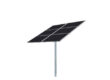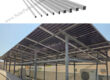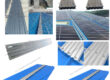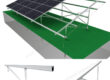

In utility-scale photovoltaic projects, the ground mounting system often becomes the hidden bottleneck of both CAPEX and OPEX. Single-pole systems may save steel on flat, uniform soil but struggle on slopes or high-wind corridors; concrete-ballasted systems add dead load and complicate drainage; lightweight aluminum spans cost more and may flex excessively under heavy bifacial modules. Solar Ground Mounting Systems — Carbon Steel N Type Double Column Ground Racking System Hot Dip Galvanized Zn-Al-Mg Coated Tilt Angle 0 to 60 Degrees Wind Load Less Than 60 m/s Snow Load Less Than 1.4 KN/M2 Concrete Ground Screw Foundation AL6005-T5 Steel for Large Scale Solar Farm Uneven Terrain Pre-Assembled (from Solar Parts Components, solarpartscomponents.com) approaches this through a geometrically distinctive double-column frame whose side profile resembles the capital letter “N”: a front post, a rear post of adjustable height difference, and a diagonal brace connecting them to form a rigid triangular load path. Fabricated primarily from carbon steel (Q235B / Q355B) with hot-dip galvanizing (HDG) or Zn-Al-Mg (ZAM) coating, and paired with AL6005-T5 aluminum rails or steel purlins, the N-type system distributes vertical (snow <1.4 KN/M²) and lateral (wind <60 m/s) loads along two axes instead of one. The front-rear column height differential inherently sets the module tilt (0°–60° adjustable via hole positions or sleeve extenders), eliminating separate tilt brackets and reducing parts count. But how exactly does the N-shaped diagonal brace improve rigidity over a simple A-frame, why does Zn-Al-Mg coating extend service life beyond standard HDG in agricultural or coastal solar farms, and how does the dual-foundation compatibility (concrete / ground screw) simplify deployment from rocky subsoil to soft arable land? Below is the full breakdown for EPCs, utility developers, structural engineers, and procurement teams evaluating ground-mount longevity and terrain adaptability.
Why the N-type double-column geometry changes ground-mount stability
The Solar Ground Mounting Systems — Carbon Steel N Type Double Column Ground Racking System Hot Dip Galvanized Zn-Al-Mg Coated Tilt Angle 0 to 60 Degrees Wind Load Less Than 60 m/s Snow Load Less Than 1.4 KN/M2 Concrete Ground Screw Foundation AL6005-T5 Steel for Large Scale Solar Farm Uneven Terrain Pre-Assembled (from Solar Parts Components, solarpartscomponents.com) is not merely an aesthetic naming choice but a structural logic:
-
Diagonal Brace as Secondary Load Path: In a single-column or H-frame, wind uplift concentrates at the base connection; in the N-type, the diagonal member (the slant stroke of the “N”) creates a triangulated truss effect between front and rear posts. This splits uplift, drag, and snow gravity loads between two footings instead of one, reducing bending moment at each pile head and allowing slimmer column profiles without sacrificing the <60 m/s wind rating.
-
Front-Rear Column Height Differential for Tilt: Instead of adding hinge brackets or adjustable purlin clamps, the N-system uses a taller rear post and shorter front post (or vice versa per hemisphere) to set a fixed or field-selectable tilt between 0° and 60°. Hole-series on the diagonal and post allow locking at 5°, 15°, 30°, 45°, etc., matching the site latitude or seasonal optimization without cutting steel on-site.
-
Terrain Following via Independent Post Adjustment: On slopes or rolling terrain, each N-unit’s front and rear columns can be cut or extended independently within the pile-driving tolerance (slotted base plates), keeping the module plane level or parallel to the slope face while the foundation follows ground contour. This avoids the massive cut-and-fill grading required for rigid single-pile arrays.
Key specifications and material strategy (From Solar Parts Components Page)
-
Product Name: Solar Ground Mounting Systems
-
System Type: Carbon Steel N-Type Double Column Ground Racking System
-
Primary Material: Carbon Steel (Q235B / Q355B) with Hot-Dip Galvanizing (HDG, ≥65µm) or Zn-Al-Mg (ZAM) coating; secondary rails/purlins in AL6005-T5 aluminum alloy or steel
-
Structure Geometry: N-shaped profile — front column, rear column, diagonal brace, top beam
-
Tilt Angle Range: 0° to 60° (adjustable via column height differential and diagonal brace hole positions)
-
Wind Load Capacity: < 60 m/s (≈216 km/h, typhoon/hurricane grade depending on code)
-
Snow Load Capacity: < 1.4 KN/M² (≈143 kg/m², moderate-to-heavy alpine/seasonal)
-
Foundation Options:
-
Concrete foundation (piers, strip footing)
-
Ground screw (helical pile) for minimal soil disturbance
-
-
Module Compatibility: Framed and frameless PV modules; Portrait and Landscape orientation
-
Installation Site: Open field, large-scale solar farm, commercial ground mount, uneven terrain (sloping, rocky, agricultural)
-
Surface Treatment: HDG (zinc ≥65µm), Zn-Al-Mg coating (enhanced edge corrosion resistance), anodizing for AL6005-T5
-
Pre-Assembly Level: Factory pre-assembled joints (bolt kits, rail connectors) to reduce on-site tooling
-
Design Life: 25 years (material warranty 10–15 years typical)
-
Standards / Testing: Compliant with ISO, CE, SGS references; structural calculation reports available
-
Supplier: Solar Parts Components (solarpartscomponents.com)
Zn-Al-Mg vs. HDG: the coating choice for 25-year ground-mount life
A defining feature of the Solar Ground Mounting Systems — Carbon Steel N Type Double Column Ground Racking System Hot Dip Galvanized Zn-Al-Mg Coated Tilt Angle 0 to 60 Degrees Wind Load Less Than 60 m/s Snow Load Less Than 1.4 KN/M2 Concrete Ground Screw Foundation AL6005-T5 Steel for Large Scale Solar Farm Uneven Terrain Pre-Assembled (from Solar Parts Components, solarpartscomponents.com) is the optional upgrade from standard HDG to Zn-Al-Mg (ZAM) coated steel:
-
Edge Self-Healing in Cut Zones: Ground-mount systems require field cutting pile heads, trimming braces, or drilling additional holes. HDG exposes bare steel at cuts; ZAM’s Mg-induced hydroxide layer creeps laterally to protect edges, crucial for N-type diagonals trimmed on-site.
-
Agricultural and Coastal Resilience: Solar farms on arable land (agrivoltaics) or near coasts face fertilizer salts, pesticides, and salt spray. ZAM’s Al+Mg microstructure resists these better than pure Zn, extending maintenance-free life toward 25 years without over-specifying stainless steel.
-
Cost vs. Life Balance: Q235B/Q355B carbon steel with ZAM costs more than HDG but far less than AL6005-T5 aluminum or SUS304 stainless, making it the economic sweet spot for megawatt-scale deployments needing >20-year corrosion control.
Foundation duality: concrete vs. ground screw in N-type systems
The N-frame’s dual-post footprint supports two foundation philosophies without altering the superstructure:
-
Concrete Foundation (Piers / Strip): On hard rock, clay, or sites requiring maximum uplift resistance, concrete piers anchor each column with rebar-caged cubes (typically 400×400×600mm or per geotech). The N-base plate uses chemical anchors or embedded bolts; this is immutable but extremely stable for <1.4 KN/M² snow zones.
-
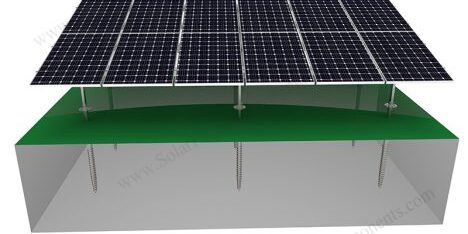
Ground Screw (Helical Pile): On soft soil, arable land (agrivoltaics), or projects needing minimal excavation, helical ground screws drive in with hydraulic machines. The N-system’s slotted base plate accommodates pile lead tolerance (±5°–10° alignment), and the double-post layout distributes lateral soil pressure better than single-pole screws in 60 m/s gusts.
-
Hybrid Scenarios: Rocky rows interspersed with soft soil may mix both — the N-type’s standardized column-to-base interface (UNP channel or plate with slotted holes) accepts either without redesigning the rack.
Typical application scenarios
-
Utility-Scale Solar Farms on Rolling Terrain: The N-type’s independent column adjustment fits gentle slopes (≤15% grade) without terracing; 0°–60° tilt covers latitudes from tropical to subarctic.
-
Agrivoltaic Ground Mounts: Height-clearance under the N-frame (set by column length) allows tractors or drip-irrigation lines beneath; ZAM coating resists fertilizer aerosols; ground screws preserve soil structure.
-
Coastal or High-Humidity PV Plants: Zn-Al-Mg coated Q235B/Q355B with 60 m/s wind rating withstands salt-laden cyclones better than thin HDG; concrete piers avoid corrosion-driven pile rot in tidal flats.
-
Retrofit of Aging Single-Pole Arrays: N-type’s double-column footprint can sometimes replace failing single piles by adding a second footing and diagonal brace, upgrading wind/snow rating without full teardown.
Installation sequence and pre-assembly advantage
-
Site Layout & Foundation: Mark row lines with nylon line; install ground screws via hydraulic driver or pour concrete piers; verify verticality and elevation.
-
Column Setting: Place front/rear columns into foundations; temporarily brace; level via adjustable base plates (shims or threaded rod extensions).
-
Diagonal & Beam Assembly: Factory-pre-assembled N-joints (bolt-and-nut sets) connect diagonal brace to columns and top beam; tighten to half torque.
-
Rail / Purlin Fit: Attach AL6005-T5 or steel purlins to top beam via U-clips or bolted saddle; ensure rail continuity for module clamping.
-
Module Installation: Lay framed/frameless PV modules in portrait/landscape; secure with mid/end clamps (SUS304 or anodized aluminum).
-
Final Torque & Inspection: Torque all carbon steel / SUS304 fasteners to spec; check tilt angle consistency across rows; verify <1.4 KN/M² snow clearance (no ponding debris on rails).
Pre-assembly at Solar Parts Components’ facility (factory matching of hole patterns, bundling of bolt kits) removes cutting/welding on-site, reducing crew size and weather-delay risk.
Sourcing checklist for developers and EPCs
When requesting a quotation for Solar Ground Mounting Systems — Carbon Steel N Type Double Column Ground Racking System Hot Dip Galvanized Zn-Al-Mg Coated Tilt Angle 0 to 60 Degrees Wind Load Less Than 60 m/s Snow Load Less Than 1.4 KN/M2 Concrete Ground Screw Foundation AL6005-T5 Steel for Large Scale Solar Farm Uneven Terrain Pre-Assembled (from Solar Parts Components, solarpartscomponents.com):
✅ Specify steel grade and coating — Q235B HDG vs. Q355B ZAM? Coating thickness (µm) and salt-spray hour target?
✅ Confirm tilt stops — Fixed holes at 0°, 15°, 30°, 45°, 60° or continuous slot (infinite adjustability)?
✅ State load environment — <60 m/s wind / <1.4 KN/M² snow sufficient or local code (ASCE/Eurocode) uplift multiplier needed?
✅ Foundation preference — Concrete only? Ground screw only? Hybrid allowed? Need pile length/diameter spec?
✅ Module data — Framed (frame height) or frameless? Portrait vs. landscape? Module width drives rail span and clamp type (AL6005-T5 vs. steel).
✅ Terrain description — Flat field? Slope %? Rocky? Agricultural? Affects column length range and foundation recommendation.
Conclusion: The N-shaped double-column as a terrain-agnostic, corrosion-resilient ground-mount backbone
The Solar Ground Mounting Systems — Carbon Steel N Type Double Column Ground Racking System Hot Dip Galvanized Zn-Al-Mg Coated Tilt Angle 0 to 60 Degrees Wind Load Less Than 60 m/s Snow Load Less Than 1.4 KN/M2 Concrete Ground Screw Foundation AL6005-T5 Steel for Large Scale Solar Farm Uneven Terrain Pre-Assembled (from Solar Parts Components, solarpartscomponents.com) reframes ground-mount design around geometric efficiency (N-truss), material economy (carbon steel + ZAM), and site flexibility (dual foundation, independent column adjustment). By resolving tilt through column height differential, distributing loads across two footings via a diagonal brace, and protecting Q235B/Q355B substrates with Zn-Al-Mg or HDG for 25-year horizons, it serves utility-scale farms on flat land and uneven terrain alike. For developers balancing CAPEX (steel grade choice) against OPEX (corrosion, regrading, foundation repair), specifying this N-type system from Solar Parts Components offers a structurally bankable, terrain-adaptive, and logistically pre-assembled path to long-term array stability.