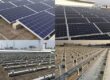

When 6 mm² string leads leaving the junction boxes of a commercial rooftop array and hanging free under the modules. By the first winter the leads were rubbing on the anodised frame edge; two had developed insulation scuffs near the connector, and the client’s O&M team wanted a fix that would not mean drilling the frames or re-tensioning a hundred cable ties. The problem was not the racking — it was the last 300 mm of cable at the module frame.
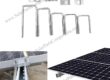
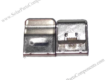
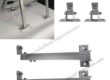
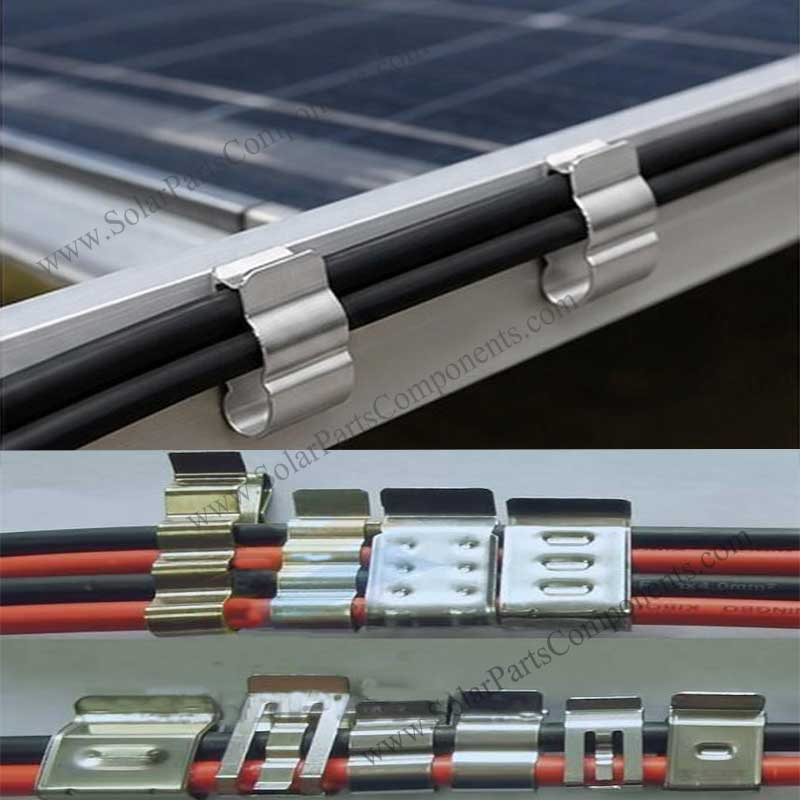
SPC’s frame clips for PV wiring are SUS304 (or SUS316) stainless spring clips that snap onto the module frame flange without tools, hold one to four DC conductors clear of sharp edges, and come in straight and 90° versions. The series is listed at 60 m/s wind and 1.4 kN/m² snow at mounting-system level, with a 10-year warranty and a 25-year design life. But “frame clip” is an overloaded term in this industry — so are frame clips for PV wiring the right part for your array, or do you actually need a rail clip, a grounding clip, or a panel-mounting edge clip?
Why a frame clip for PV wiring is a wire-management part, not a panel clamp or an earthing clip
- It attaches to the frame flange to hold cable, not to hold the module. A frame clip for PV wiring grips the return edge of an anodised aluminium module frame and gives the DC lead a smooth, fixed exit path. Module restraint is the job of mid and end clamps on the rail — a wire clip is never counted in the uplift calculation.
- It is not the “edge clip” sold as a panel-mounting component. SPC also lists a panel-mounting edge clip (SPC-PV-CC17) made of C67S steel and polyamide for 1.5–3.5 mm panels. That part secures panels; it does not manage wiring. The wire-routing part is the SUS304 90° SPC-PV-CC05 edge clip or the CC01/CC03/CC09/CC10 clip family. Check the model code, not just the word “edge”.
- It is not an earthing device. Bonding frames and rails is done with dedicated grounding clips; a stainless wire clip must never be specified as the electrical bond path.
- Gate size follows cable outside diameter. “4mm/6mm” in a product title usually means 4 mm² / 6 mm² conductor cross-section, but a clip gate is sized by OD: a 4 mm² PV cable is typically about 6–7 mm OD, 6 mm² about 7.5–8 mm OD. CC01 accepts 4.0–8.0 mm, CC03 up to 8 mm, CC09 is listed at 4.0 / 5.0 / 6.0 mm and CC10 at 5–9 mm. Order against the jacket OD.
- Frame thickness is a separate, model-specific fit. CC03 is specified for 1.0–2.5 mm rail or frame, CC10 for 1–3 mm, CC09 for 1–2 mm edges, and the CC01 CN listing gives 1.3–2.5 mm. Measure the flange before placing a bulk order — the numbers are not interchangeable across models.
“Frame clips for PV wiring” describes a mounting position, not a single universal part. The right choice depends on the cable outside diameter, how many conductors pass through the gate, the frame flange thickness, and whether the run turns 90° at the module edge — SUS304 as standard, SUS316 where chlorides demand it, backed by a 10-year warranty and 25-year design life. The cheap alternative, a generic zip tie or a panel-mounting edge clip used in the wrong role, does not survive the UV, abrasion and service calls that a framed PV array delivers. For a gate-by-gate comparison, start at the SPC cable clip range or the SPC-PV-CC09 four-wire page and send your frame drawing for confirmation.