
What is a rectangular steel tube (RHS)?
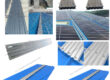
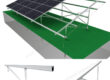
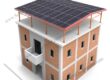
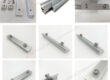
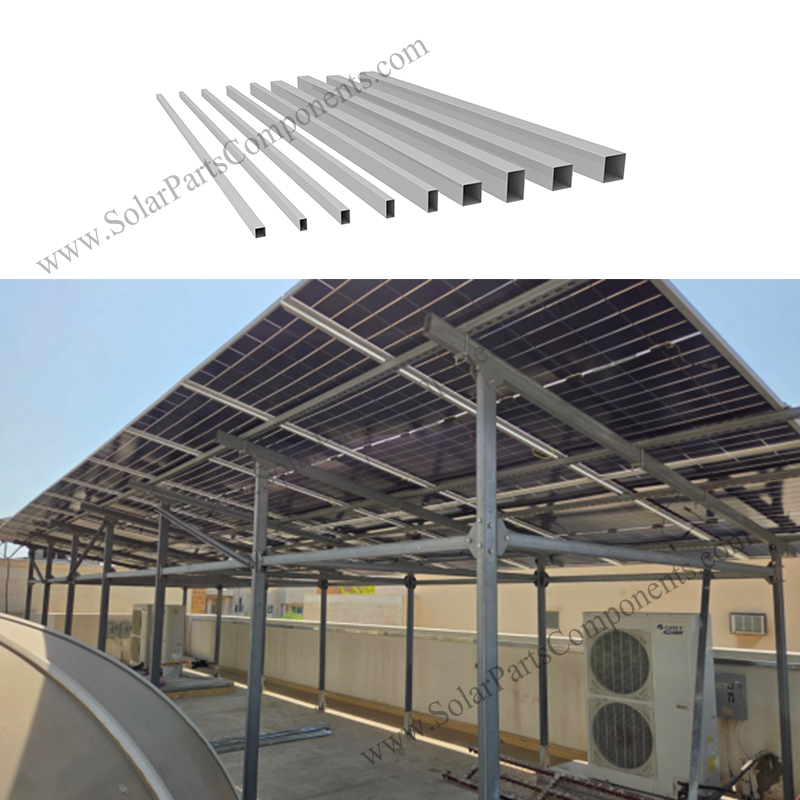
A rectangular steel tube – RHS, short for Rectangular Hollow Section – is a closed, welded steel profile with a rectangular cross section. You specify it by width x height x wall thickness, for example 80 x 40 x 3.0 mm. In solar mounting structures it shows up as module rails, purlins spanning between columns, and main stringer beams on ground-mount and carport systems.
The reason engineers keep specifying it comes down to physics: bending resistance comes from steel placed far from the neutral axis, and a closed rectangular section keeps its material at the outer fibres. For the same weight per metre, RHS delivers a higher section modulus than C channel, Z purlin or equal angle. Two more structural bonuses:
- it is doubly symmetric – the shear centre sits at the centroid, so loads applied to the face of the tube do not create the torsional eccentricity that plagues open profiles;
- the closed box gives it far higher torsional stiffness than a channel of the same weight, which matters under wind uplift and unbalanced snow.
On site, the flat faces are a quiet advantage too: rail brackets, clamps and bolts seat flush against the tube, which speeds up installation and keeps structural analysis simple.
Which is stronger – RHS, C channel, or Z purlin – for solar mounting?
For the load spectrum a solar array actually sees – wind uplift, wind torsion, uneven snow – RHS outperforms both, section for section. Same steel weight, more load carried.
- A C section is open and singly symmetric. Under face-applied or uplift loads it wants to twist, so it needs sag rods or bracing that a closed tube simply does not. Per kilogram, RHS carries noticeably more bending moment.vs C channel:
- Z sections lap into continuous spans, which makes them efficient long-span purlins in building roofs. But they are still open profiles – the torsional behaviour and the bracing requirement do not go away. In a PV structure where wind torsion is a design load, that difference is decisive.vs Z purlin:
Where C and Z still make sense: short simple spans, lightweight roofs, and projects where the lowest price per metre wins the tender. As a rough decision table:
| Property | C Channel | Z Purlin | RHS (Rectangular Tube) |
| Bending efficiency per kg | Good | Very good (lapped spans) | Best – closed section, outer fibres |
| Torsional resistance | Moderate – needs bracing | Moderate – needs bracing | High – closed box, no bracing |
| Behaviour under wind uplift | Twists | Twists | Resists without added bracing |
| Connections | Simple | Lap bolting | Flat faces, clamps seat flush |
| Typical solar use | Wall girts, small spans | Long building purlins | Rails, PV purlins, main beams |
Honest answer for an engineer: for a given span and load case, run the numbers on all three. What you will usually find is that RHS lets you stretch the span between foundations – fewer piles, fewer footings, less steel in the ground – and that is where the real money is on a ground-mount project.
What are the common specifications and sizes for rectangular steel tubing in solar arrays?
Solar work uses a narrower size range than general construction. The most requested sections, with their typical jobs:
| Section (mm) | Wall (mm) | Typical use in PV mounting |
| 60 x 40 | 2.0 – 3.0 | Purlins and rails, residential and C&I systems |
| 80 x 40 | 2.0 – 3.0 | Purlins and main beams – the workhorse size |
| 80 x 60 | 2.5 – 4.0 | Main beams on larger fixed-tilt arrays |
| 100 x 50 | 3.0 | Main beams, longer spans between foundations |
| 120 x 60 | 3.0 – 4.0 | Heavy main beams, large-format modules |
| 150 x 100 | 3.0 – 5.0 | Carport beams and heavy structures |
Material and coating, as we supply it:
- base grade S350GD per EN 10346 – 350 MPa yield, versus 235 MPa for the common Q235B tube, so the same load needs less steel;
- Zn-Al-Mg (ZAM) coating, ZM275 – 275 g/sq m minimum triple-spot, applied on coil so the inside of the tube is protected too;
- standard length 6 m or cut-to-length to your BOM; custom sections and pre-punching on request.
One detail that is easy to miss: orientation. A 50 x 100 tube bends far more efficiently around its deeper axis, so beams go in with the 100 mm dimension vertical. If you are not sure which way a section should run, send us the drawing – getting this wrong quietly halves the capacity you paid for.
What coating best protects rectangular steel tubes in harsh or coastal environments?
Zinc-Aluminium-Magnesium – ZAM, also written Zn-Al-Mg or ZM – is the answer for coastal, high-humidity and industrial-pollution sites. It is not a marginal upgrade over hot-dip galvanizing (HDG); the performance gap is an order of magnitude:
| Coating | Salt spray to red rust (ISO 9227) | Cut edges and drilled holes | Coastal C4 service life |
| Standard galvanized (pre-gal) | ~500 hours | Rust creep starts at every cut | Poor – not recommended |
| Hot-dip galvanized, 275 g/sq m | ~1,000 hours | Needs zinc-rich paint touch-up | 8 – 12 years |
| HDG heavy, 600 g/sq m | ~1,500 hours | Needs touch-up | 12 – 15 years |
| ZAM (Zn-Al-Mg), 180 – 275 g/sq m | 3,000 – 5,000+ hours | Self-healing – alloy migrates over exposed steel | 25 – 30 years |
| ZAM + epoxy topcoat | 8,000+ hours | Self-healing + barrier | 30+ years, C5 splash zones |
The mechanism behind the numbers: the magnesium in the coating forms a dense, adherent corrosion product (simonkolleite) that seals surface defects. When the tube is cut or drilled on site, magnesium-rich ions migrate across the exposed edge and re-cover the bare steel. On ordinary HDG, that same cut edge is where red rust starts – and PV structures get cut and drilled constantly during installation.
Three practical rules to actually get the protection you paid for:
- specify weep or drain holes (or unsealed ends) on closed sections so internal condensation can escape;
- repair field welds with zinc-rich paint – welding burns off any coating, ZAM included;
- use A4/316 stainless fasteners so the bolts do not become the weak link.
How durable are ZAM-coated rectangular tubes for 25+ year solar projects?
Designed to match the plant – that is the honest engineering answer, and the data supports it for C3 to C4 environments. Here is how to think about it.
What actually kills steel structures in year 10 or 15 is not the flat surfaces – it is corrosion starting at drilled holes, cut ends and fastener points, exactly where the coating was disturbed. ZAM is built for that failure mode: the self-healing effect protects every hole your installers drill and every end your fabricators cut, without touch-up paint.
On the numbers: ZAM sections at ZM275 hold 3,000+ hours in neutral salt spray before red rust, versus roughly 1,000 for equivalent HDG – and hold their section properties over a 25-year design life in tropical coastal sites across Southeast Asia, where most premature corrosion failures get reported.
What the supplier cannot fix for you – the conditions that must be in the drawings:
- weep/drain holes on closed sections, or specified open ends, so condensation does not sit inside the tube;
- zinc-rich paint on all field welds;
- isolation from dissimilar metals at contact points;
- a coating weight matched to the site class – ZM275 for structural members, not lighter coil grades.
Get the detailing right and the structure is maintenance-free for the asset life of the plant. Skip it, and no coating will save the project – that is true for stainless steel too.
What is the cost comparison between rectangular tube and other profile types?
We do not quote fixed prices here – steel moves, and your project volume decides the number. But the cost structure is worth understanding, because the cheapest profile per metre is often not the cheapest structure per watt:
| Option | Upfront cost | Lifecycle cost | What decides it |
| C / Z purlin (HDG) | Lowest per kg | Medium – re-coating and bracing add up | Simple spans, light loads, budget tenders |
| RHS + ZAM (S350GD) | Slightly higher per kg | Lowest on coastal and long-span projects | Fewer foundations, no bracing, no maintenance |
| RHS + HDG | Medium | Medium – inspection cycles in C4+ | Inland projects with tight CAPEX |
| Aluminum profiles | 3 – 4x structural steel | Low-medium | Rooftop weight limits, corrosion-absolute sites |
Where RHS + ZAM quietly saves money on a ground-mount:
- longer clear spans mean fewer piles and footings – foundations, not steel, are usually the biggest buried cost on a ground-mount;
- 350 MPa base steel means thinner walls for the same load – less steel tonnage, and less freight per MW;
- no bracing or sag rods to fabricate and install;
- no re-coating cycles for the life of the plant – with HDG in a coastal C4 site, budget for inspection every 3 – 5 years and local re-coating at damage points.
The right question to ask a supplier is not the price per metre – it is the installed structure cost per watt for your site class and span. We run that comparison on request, with your wind and snow load case.
Do you also supply hot-dip galvanized options alongside ZAM coating?
Yes – both, and the choice is driven by your site, not by our preference.
- the default for anything coastal, tropical, high-humidity or near industrial emissions. Coated on coil, so the inside of the tube is protected too, and cut edges self-heal. Best for roll-formed purlins and rails with pre-punched holes.ZAM (S350GD+ZM, EN 10346):
- the proven budget option for inland C2 – C3 sites. Post-fabrication dipping gives a thick, uniform deposit and covers welds – the better route when your structure involves welded assemblies.Hot-dip galvanized (HDG):
Same base grades, same tooling, same pre-punching and cut-to-length service either way. If your project sits within a few kilometres of the coast, or in a tropical monsoon climate, we will push you towards ZAM – the HDG saving up front is smaller than the re-coating cost it buys later. Send the site location and environment class and we will recommend one with reasons, not just a price.
How do I specify the right size and thickness for my ground-mount project?
The rule of thumb that holds across most projects:
span determines section depth – load determines wall thickness – environment determines coating.
In practice the calculation is driven by four inputs:
- design wind speed and snow load per your local code – ASCE 7, EN 1991-1-4, AS/NZS 1170.2, GB 50009. Terrain category matters, not just the regional number;
- pile or foundation spacing you are planning – wider spacing pushes you to a deeper section, and often that trade is worth making;
- module format and layout – large-format and bifacial modules change the rail loads;
- soil and foundation type – driven piles versus concrete footings change what the beams have to span.
To get an accurate quote and section recommendation in one round, send us this checklist:
- size and wall thickness (B x D x t) if already specified, e.g. 80 x 40 x 3.0 mm – or just the load case and spans, and we will size it;
- lengths and quantities, per BOM or drawing;
- pre-punching and cutting drawings – PDF, DXF or DWG;
- destination port, for freight and lead-time calculation.
Our engineers confirm orientation (deep axis vertical), section and coating per your load case, and come back with a section recommendation and a quote – usually in one round if the checklist is complete.